
Research and delivery
How to organise a teams work.

So, you’ve got a team, and they’re beavering away.
Given all the work they could do, what is the work that they should be doing?
We need to talk about how we organise work - into delivery work, and research work.
Step 1- A post-it for each item of work - and Draw and label an X and Y axis
To begin, write down each need/painpoint/objective that the team could work on. Each thing is on one posit note.
Now we need to organise these posits. You can choose the labels that you use on the x and y axis, but we like the terms ‘validated’ (there is evidence that this work is needed) and ‘not validated’ (we’re not sure the work is needed). On the x axis we have ‘important’ to ‘not important’.
Step 2 - Position the post-its - Mapping the work onto the axis
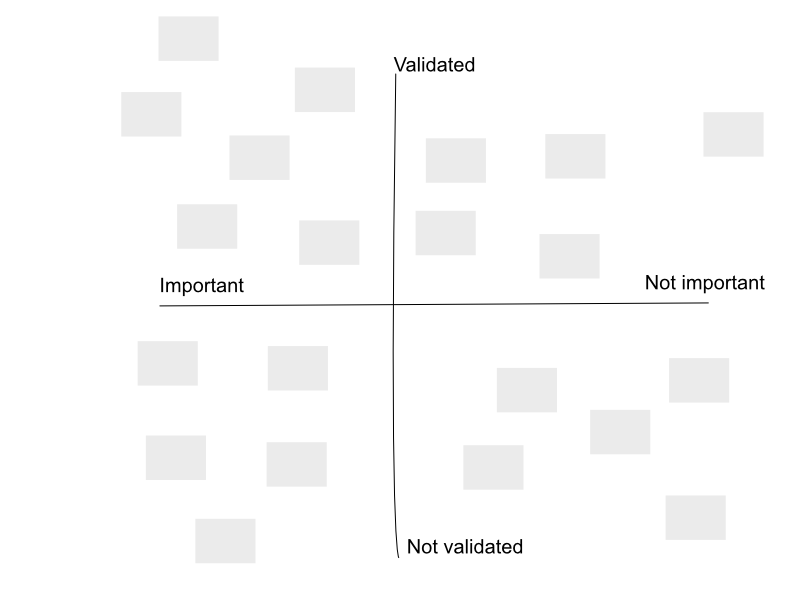
Take each of the pieces of work and position it on the x and y axis. The more important the work, the further to the left it goes. The more evidence there is that this work is needed, the higher it goes on the Y axis.
It can help if you do positioning the postits as a team exercise, with everyone contributing and discussing which work items are most important, and have the most evidence to validate their importance.
Step 3 - organise the work onto your roadmap
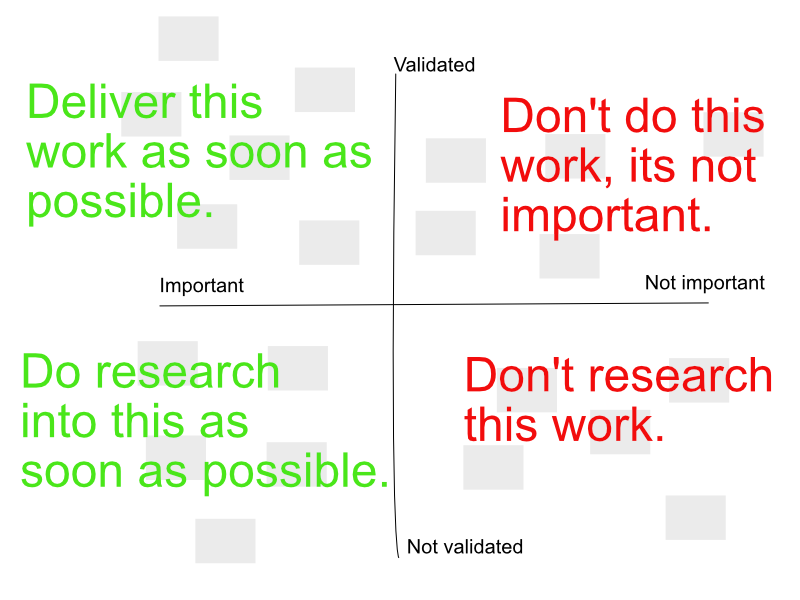
From the mapping you did in Step 2, your roadmap should now take everything in the top left quadrant (important and validated). This is your delivery quadrant - your team should be delivering the work in this quadrant as soon as possible.
The quadrant bottom left is also important, but it is not yet validated. This work needs further research to validate (or invalidate) it. This is your ‘research’ quadrant. Some members of your team should do the research needed to validate these work items.
The other 2 quadrants consist of work that you and the team feel is not important. So, don’t do this work.
Step 4 - Doing work that is less important, but is depended on by work that is very important.
Sometimes you’ll spot work that needs to be done in order to enable you to deliver the most important validated work items. This is the only criteria for considering working on less important work items.
If you’ve run out of important work to do…….
Step 4 - talk to your customers to identify new work that is important and validated
As you talk to more customers about your service, their needs and pain points, they’ll tell you about new needs, new painpoints, new opportunities for your team to produce work that customers find useful. Each new insight should be prioritised - is it important? Is it validated?
The most important work to do is furthest to the left. This is the work the team should be focussed on.
Conclusions
We use this technique all the time to figure out what to deliver next, and where further research is required.
Your team should be delivering the work that is important and validated, and researching the work that is important but not yet validated.
We hope it helps your team to clarify the work to be done, and to organise their roadmap of work.
Thanks for reading.
Questions or comments?
Feel free to get in touch with your questions or comments - email admin@focust.co.uk